
The Signal Framework: A LinkedIn & Social Selling Strategy.
I've been doing this social selling thing for 15 years.
Over that 15 years, I've worked with solopreneurs, sales teams, huge marketing departments and board level leaders - all of them reach out to me with a common complaint:
"We putting a lot of effort into LinkedIn, but we're not getting much out of it"
Working with hundreds of clients, the same three always pop up. It doesn't matter what size of business or what industry - this are the three issues I always work with them to fix.
It's always the same three problems:
- Buyers don't see the value: This is often caused by a disconnect between the target audience, the message and the services your marketing/selling.
- Buyers don't know you: Leads don't come from one touchpoint, in fact, buyers hit the sweet-spot of preference between 10 and 20 exposures.
- You don't capture and convert leads: Trying lots of tactics can yield a few lucky wins, but it's systems that build consistent results.
You need all three working together to be successful with Social Selling and result the clients you want from LinkedIn.
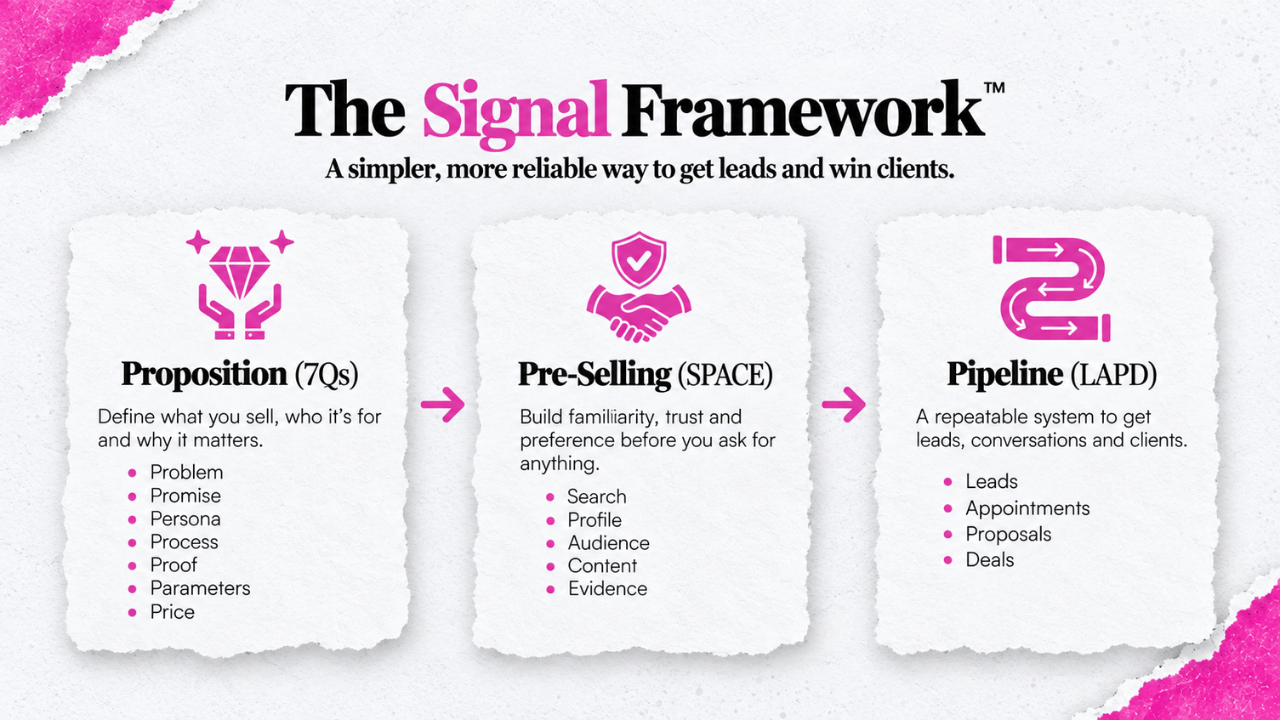
I developed The Signal Framework to fix these issues. It's a comprehensive Go-To-Market strategy for LinkedIn. I've delivered and implemented this with many of my One-on-One coaching clients and across larger teams in companies around the world.
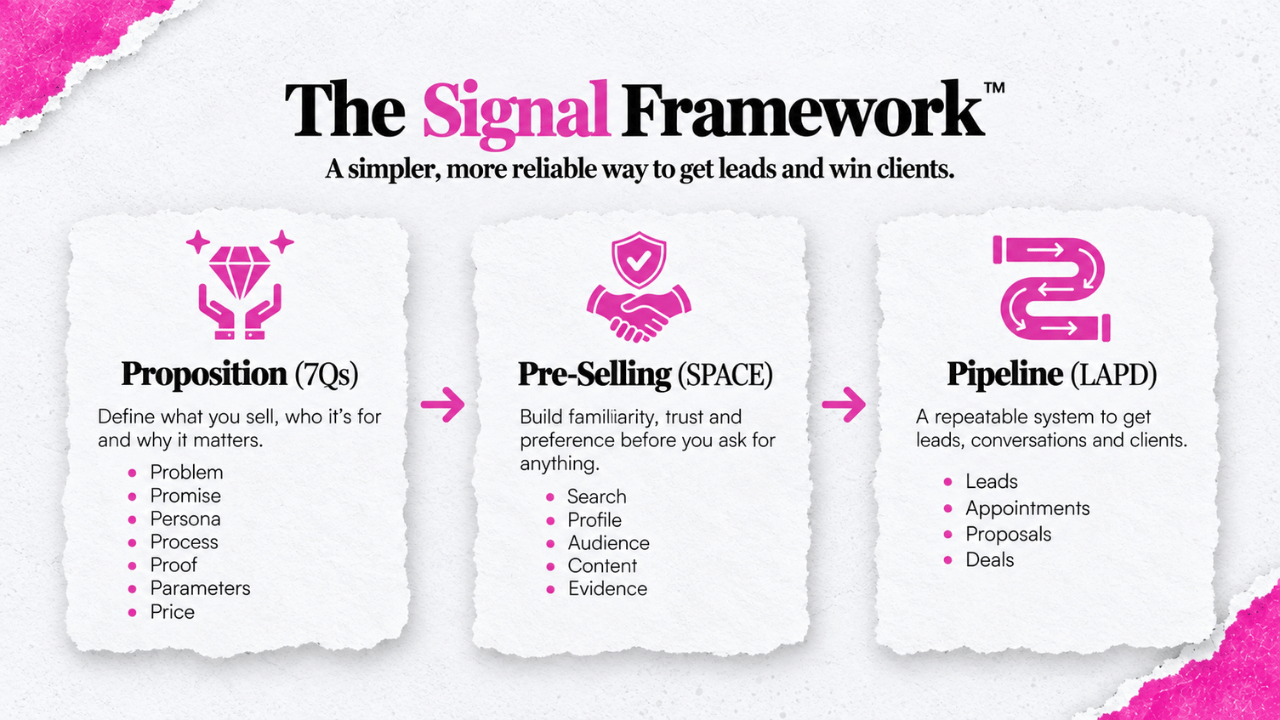
The power of The Signal Framework is incredible. It makes your value and message clear, builds your content strategy and gives you a path to winning clients. It's the most comprehensive social selling strategy for winning clients on LinkedIn that exists.
In a live on YouTube, I broke it down in detail, video below:
Proposition: The foundation for faster ROI.
If you’re a generalist on LinkedIn, it’s going to be harder. If you’re a specialist, it gets easier.
Specificity gives people a reason to recognise themselves in what you do. It sharpens your offer, your audience, your message and the content you create.
There are seven questions that sit underneath a strong proposition:
- What problem do you solve?
This is the specific issue your ideal client wants resolved. It matters because people pay attention when they recognise a problem they’re already experiencing, especially when it feels urgent, costly or frustrating. - What promise do you offer?
This is the change, result or outcome they can expect from working with you. It matters because people don’t buy the process itself; they buy the possibility of moving from where they are now to somewhere better. - Who is your ideal client profile?
This defines the person, role, situation or context your proposition is built for. It matters because the more specific you are about who it’s for, the easier it is to make your message relevant and recognisable. - What is your process or method for solving the problem? This is the 3–5 step methodology that takes someone from the problem to the outcome. It helps them visualise how they’ll get there, gives them confidence in your approach and shows there’s a credible path behind the promise.
- What proof do you have that you can do it? This is the evidence that supports your promise, including client outcomes, case studies, experience, expertise or track record. It matters because proof reduces perceived risk and gives people a reason to trust that you can deliver.
- What are the parameters of your service? This defines what the client is actually buying: the scope, duration, format, access and boundaries of the engagement. It matters because without this your service can feel intangible, so clear parameters make the offer easier to understand and evaluate.
- What is your price? This is what the client needs to invest to work with you. It matters because price affects positioning, perceived value and fit, and it has to make sense in relation to both the problem being solved and the outcome being promised.
If you can’t answer these seven questions specifically, you’re still generalising.
And if your proposition is general, your LinkedIn activity will be general too. You’ll blend in. You’ll talk to too many people, about too many things, with no clear reason for the right person to think:
“This is for me.”
Clarity in your proposition creates clarity everywhere else.
These answers define your Go-To-Market strategy for LinkedIn, they tell you:
- How to position your profile
- Who you need to connect with.
- What content you need to create.
- What gets the ideal client's attention.
- How to differentiate from your competitors
But there’s one test that matters across all seven… Do they want enough to pay for it?
Your ideal client’s respond to what they already want, they are motivated by that - that’s what they’ll engage with and pay for.
If you focus on their need - they may not recognise the need and you’ll have to educate them why they need it.
People know what they want, but they rarely know they need to get there.
If you lead with the need, you’re only speaking to the small number of people who have already worked that out for themselves.
By that point, they’re often just comparing providers.
If you understand what your client wants, you can build an offer, set up your profile, build a client acquisition system on LinkedIn that is more predictable and slash how much time you need to spend on LinkedIn.
Pre-Selling: The key to creating demand.
Now you’ve got clear on your proposition, you can start to pre-sell you and your services.
Pre-selling works on a simple principle: people need to become familiar with you, your value and your offer before they’ll seriously consider buying.
Pre-selling is planting the seed ahead of time that you:
- You understand a problem they care about
- You help create an outcome they want
- You work with people like them
- You have a credible way of getting them there
- You have evidence that you can do it
The Mere Exposure Effect helps explain why. Repeated exposure builds familiarity, and familiarity influences belief, preference and trust. On LinkedIn, most people won’t see you once and enquire. They will need 10–20 exposures to you, your ideas, your value and the same consistent proposition before they feel ready to take the next step.
It's surprisingly easy to build up 10-20 exposures in as little as 2-3 weeks.
Pre-selling is critical if you want a simpler and more sustainable way to win clients on LinkedIn - It’s an ecosystem you build so your ideal clients feel the fit. As an example, when sellers do this, or anyone for that matter, they see an response rate to outreach treble. When we implemented this with Salesforce, they had a 302% increase in response rate compared with their previous LinkedIn outreach strategy.
Pre-Selling creates SPACE for people to see why they need to invest with you…
There are five parts to SPACE - these aren’t one off things - it’s how you build and maintain your familiarity, trust and preference.
- Search: Can they find you online and does what they find supports what you say on LinkedIn. (Blogs, news stories, websites).
- Profile: Setup your profile for buyer familiarity and education. From the banner to the recommended section, your profile should be doing the heavy lifting of buyer education.
- Audience: Grow your network with the exact ideal client profile daily. (20 per day) so you have audience of ideal clients that are looking at your profile and seeing your content.
- Content: Post content that help people buy into you, build that familiarity and interest for what you offer. (2-3 per week).
- Evidence: Prolifically share proof of your success working with clients. (Case studies, testimonials, quotes).
This prepares the soil for what we do next.... build pipeline.
Pipeline - The Lead To Deal System.
Winning clients on LinkedIn isn’t just about getting an inbound lead. You’ve got to get them all the way through the pipeline to convert into a paying client.
That isn’t ‘doing LinkedIn’, it's a business critical system.
If you’ve built your practice on referrals - your existing system isn’t ready for LinkedIn leads.
Many will hire agencies to generate leads and despite the agency driving leads - the leads are from cold outreach or paid campaigns - compared to referrals, those leads are stone cold.
Referrals are the best kind of lead - no question about it.
If that’s all you’ve known, you probably don’t have the sales skills to handle leads from cold campaigns - and most have zero desire to learn them.
This means a lead an experienced salesperson would close, you’d probably lose.
Pre-sold leads are better than cold.
Pre-sold leads are the best kind of leads, second only to referrals.
Unlike cold leads, they have a level of trust and familiarity - this doesn’t mean you can treat them like referrals.
It doesn’t mean you can handle them like referrals, but you don’t need to have good sales skills to convert them.
This is where segmentation and the narrow focus from your Proposition helps you.
Because you have the same problem, promise and ideal client profile - many of your sales conversations will be similar. So, you can create a repeatable process to move leads through your pipeline.
Most don’t need complicated sales systems, they need a 4 step process, I call it LAPD.
It stands for:
- LEADS: There are 5 repeatable ways to get leads on LinkedIn, you just need to master one of them.
- APPOINTMENTS: Once you capture a new lead, knowing what and how to move that lead to a booked conversation - it’s not as simple as offering a call.
- PROPOSAL: One the call you have a structure that helps you uncover what matters most for them - what they really want - and you can align that to your offer.
- DEAL: They’ll leave motivated and see why they need your services. But they’ll forget that and momentum will slow - you have to help keep the momentum so they make the final decision.
Systems not pressure.
Just a note to say, this process is not about turning no into yes. I personally disagree with that philosophy - I don’t think you can flip someone ethically. Even if you could, their commitment to the buying process would probably wane and the relationship wouldn’t work out.
This is about preventing ‘yes’ slipping into a ‘maybe’ or a ‘not now’ and in some cases turning a ‘maybe’ or a ‘not now’ into a ‘yes’. When you don’t have a process for handling social selling leads and moving them through the process, they lose them.
When I work with clients, we build processes and baseline templates for each step of the LAPD process. How they get leads, how they book them onto calls, how they run those calls, how they explain their offer and how they sustain momentum until they close the deal and win the client. Do you have this system in your business?
Are you ready to install The Signal Framework?
We can work with you to install the framework into your business and support you getting LinkedIn to deliver reliable results.
If you'd like to know about you can get this installed and working for you in the next 30-days, schedule a call here.
Author